How to Import Millets from India: Step-by-Step Guide for Bulk Buyers
India is the world's largest producer of millets, accounting for approximately 80% of global production. With the International Year of Millets boosting demand, international buyers are increasingly sourcing millets from India. Here is your complete import guide.
Why Import Millets from India?
- Largest global producer: Over 17 million metric tons annually
- Variety: Sorghum (Jowar), Pearl Millet (Bajra), Finger Millet (Ragi), Foxtail Millet, Little Millet, Barnyard Millet
- Competitive pricing: 20-30% lower than African or Chinese alternatives
- Government support: APEDA actively promotes millet exports with quality assurance programs
- Organic options: Growing organic millet production in Rajasthan, Karnataka, and Tamil Nadu
Step 1: Determine Your Millet Type and Specifications
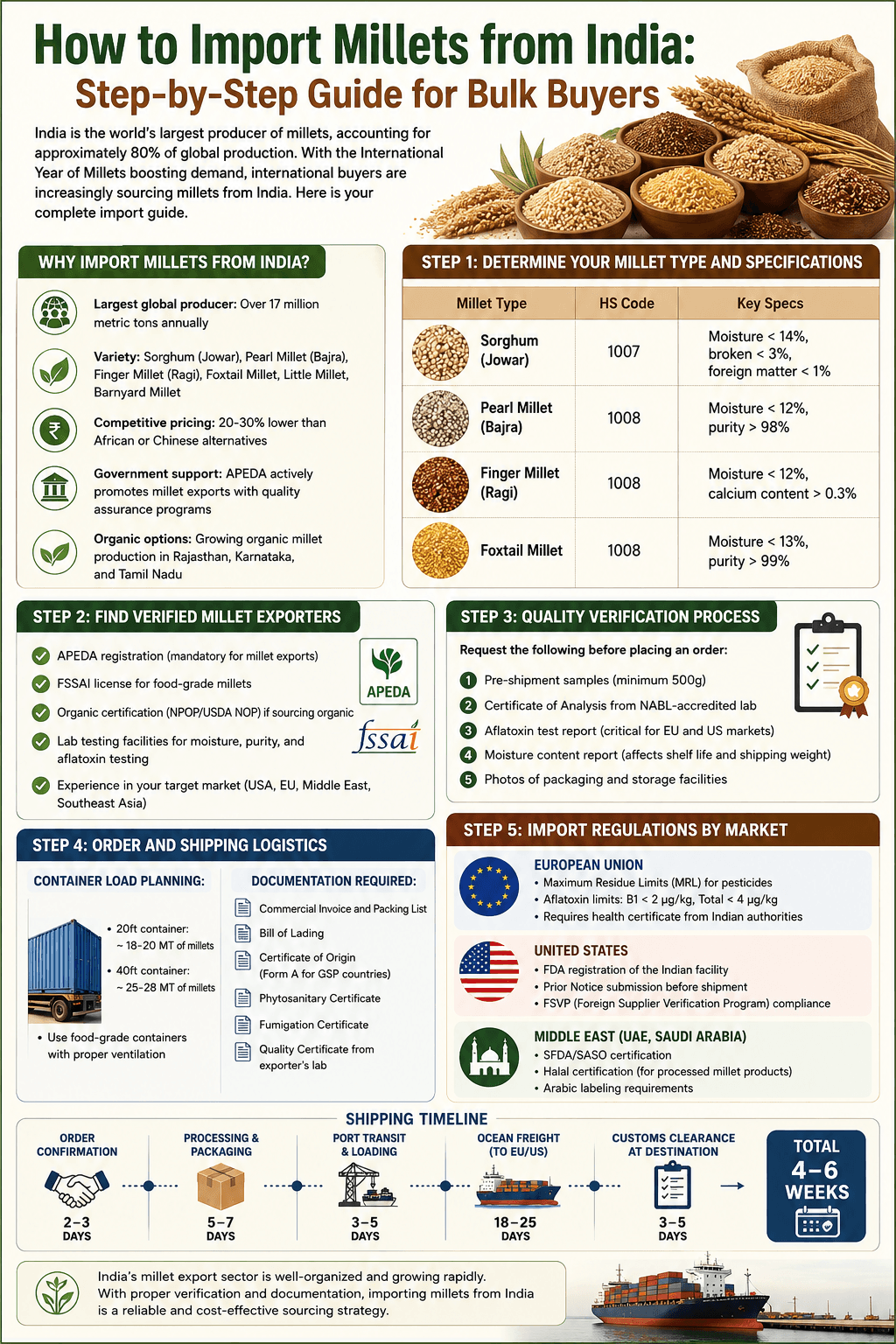
| Millet Type | HS Code | Key Specs | |------------|---------|-----------| | Sorghum (Jowar) | 1007 | Moisture < 14%, broken < 3%, foreign matter < 1% | | Pearl Millet (Bajra) | 1008 | Moisture < 12%, purity > 98% | | Finger Millet (Ragi) | 1008 | Moisture < 12%, calcium content > 0.3% | | Foxtail Millet | 1008 | Moisture < 13%, purity > 99% |
Step 2: Find Verified Millet Exporters
Look for exporters with: - APEDA registration (mandatory for millet exports) - FSSAI license for food-grade millets - Organic certification (NPOP/USDA NOP) if sourcing organic - Lab testing facilities for moisture, purity, and aflatoxin testing - Experience in your target market (USA, EU, Middle East, Southeast Asia)
Step 3: Quality Verification Process
Request the following before placing an order: 1. Pre-shipment samples (minimum 500g) 2. Certificate of Analysis from NABL-accredited lab 3. Aflatoxin test report (critical for EU and US markets) 4. Moisture content report (affects shelf life and shipping weight) 5. Photos of packaging and storage facilities
Step 4: Order and Shipping Logistics
Container Load Planning: - 20ft container: ~18-20 MT of millets - 40ft container: ~25-28 MT of millets - Use food-grade containers with proper ventilation
Documentation Required: - Commercial Invoice and Packing List - Bill of Lading - Certificate of Origin (Form A for GSP countries) - Phytosanitary Certificate - Fumigation Certificate - Quality Certificate from exporter's lab
Step 5: Import Regulations by Market
European Union: - Maximum Residue Limits (MRL) for pesticides - Aflatoxin limits: B1 < 2 µg/kg, Total < 4 µg/kg - Requires health certificate from Indian authorities
United States: - FDA registration of the Indian facility - Prior Notice submission before shipment - FSVP (Foreign Supplier Verification Program) compliance
Middle East (UAE, Saudi Arabia): - SFDA/SASO certification - Halal certification (for processed millet products) - Arabic labeling requirements
Shipping Timeline
| Stage | Duration | |-------|----------| | Order confirmation | 2-3 days | | Processing and packaging | 5-7 days | | Port transit and loading | 3-5 days | | Ocean freight (to EU/US) | 18-25 days | | Customs clearance at destination | 3-5 days | | Total | 4-6 weeks |
India's millet export sector is well-organized and growing rapidly. With proper verification and documentation, importing millets from India is a reliable and cost-effective sourcing strategy.